Answering the search intent directly: these drill attachments efficiently cut circles, arcs, and rounded holes in metal, wood, and plastic. They’re ideal for DIYers, hobbyists, and professionals who need precise circular cuts with a standard drill. The top picks below are best for different materials and project scales—from light woodworking to metal fabrication. The buyer-friendly table highlights each product’s scope and ideal user.
| Product | Best For | Material Range | Notes |
|---|---|---|---|
| 9pcs Drill Cutting Wheel and Saw Bit Set (AUUTI) | General circular cuts in metal, wood, plastic | Wood, Plastic, Metal | Solid HHS bits; easy to install |
| LifCratms Adjustable Hole Saw | Large diameter circles | Plywood, drywall, plastics | 30mm–300mm range; carbide blades |
| Dicfeos Double Head Sheet Metal Cutter | Straight, curve, and circle cuts | Sheet metal and tougher alloys | 360° double cutting head; burr-free |
| FOTYBEI Cutting Wheel for Drill | Versatile disc cuts in tight spaces | PVC, wood, metal, plastic | Includes multiple blade sizes; hex shanks |
| Zreneyfex 360 Degree Double Head Nibbler Cutter | Complex curves and circles | Metal sheets | Double-head design; variable cuts |
9pcs Drill Cutting Wheel and Saw Bit Set – AUUTI

The AUUTI set uses solid HHS material for sharp, durable cutting wheels and a high-strength carbon steel handle. It is designed for compatibility with most electric drills and emphasizes fast, precise cuts. Best for professionals and serious DIYers who need reliable, interchangeable circle-cutting tools for metal, wood, and plastic projects. A practical choice for cutting holes, circles, and profiles in softer or thin metals and plastics.
Best for: “General circle cuts” and frequent use in metal, wood, and plastic work. A limitation: not optimized for very thick metals beyond the kit’s typical applications.
LifCratms Adjustable Hole Saw 1-3/16″ to 11-3/4″

Designed for large-diameter circle cutting, LifCratms offers a range from 1-3/16″ to 11-3/4″ with a 3/8″ tool handle. The carbide blade construction provides durability across repeated use on wood, gypsum board, plywood, plastic, and other soft to medium-density materials. It’s best for DIY projects that require clean circular openings in walls or panels.
Best for: large hole sizing and stable cutting with a dedicated circle cutter. Caution: suitable for drill presses or stable setups; ensure your drill can handle the extended diameter.
Dicfeos Double Head Sheet Metal Cutter

Dicfeos features a 360-degree double-cutting head for straight lines, curves, and circles. The HSS blades enable cutting through various sheet metals and other tough materials with precision. This attachment suits projects like ductwork, automotive repair, and metal fabrication where clean, round cuts are essential.
Best for: complex shapes and uniform circular cuts in metal. Limitation: may require careful control to prevent chatter on very thick sheets.
FOTYBEl Cutting Wheel for Drill
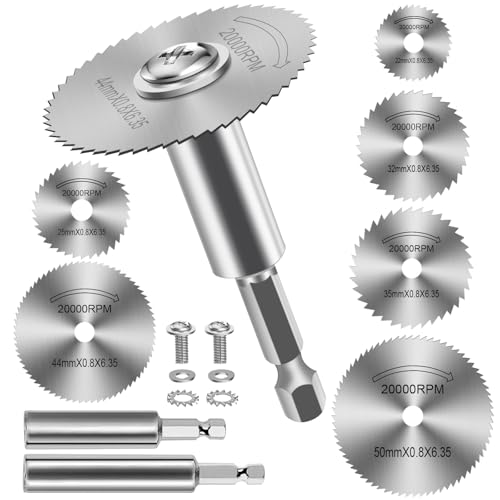
The FOTYBEI kit includes six replaceable mini saw blades with 1/4″ hex shanks and two shaft lengths. The alloy steel construction provides hardness and durability for cutting PVC pipes, wood, metal, and plastic. This option excels in tight spaces where a larger tool would be impractical and offers varied blade sizes for precise circle and hole work.
Best for: tight spaces and a versatile range of cut sizes. Caution: blade changes require careful handling to avoid misalignment during use.
Zreneyfex 360 Degree Double Head Nibbler Cutter

The Zreneyfex nibbler offers a 360-degree cutting capability with a double head for creating precise curves and circular openings in metal sheets. It fits drills operating between 1500–3000 RPM and supports cutting through stainless steel, aluminum, copper, and other metals. It’s a solid choice for HVAC, automotive, and renovation projects that require clean circular pockets or rounded panels.
Best for: circular holes and complex cuts in metal sheets. Limitation: better suited for sheet metal than thick plates; ensure compatible drill speed and control.
Buying Guide: Circle-Cutting Attachments
What material will you cut?
Consider whether you’ll work with wood, plastic, aluminum, steel, or stainless steel. Some tools excel on soft materials, while others are built for tougher metals. Choose blades or cutters with appropriate hardness and durability for your primary material.
What diameter do you need?
Diameter range matters. If you frequently cut large holes, pick an adjustable or high-range tool like the LifCratms model. For standard circle cuts, a kit with multiple blades may be more cost-effective.
Is space and access a factor?
Compact or tight spaces benefit from mini or short-shank tools, such as the FOTYBEI kit. If you need precise, burr-free edges, consider nibblers or double-head cutters designed to minimize post-processing.
Is your drill compatible?
Most attachments use a 1/4″ hex shank. Confirm your drill’s chuck compatibility and RPM ratings (some attachments specify an RPM range, like 1500–3000). Avoid overloading a drill beyond its intended use.
Safety and control considerations
Use proper PPE, stabilize the workpiece, and maintain steady feeds to reduce burrs and save blade life. When cutting metal or hard materials, clamp pieces securely and work slowly to maintain accuracy.
Maintenance and longevity
Carbide and HSS blades offer longer life under heavy use, but blade replacement is common. Keep blades sharp, clean off debris after use, and store attachments in a dry place to prevent corrosion.
FAQ
Q: Can these attachments be used with any electric drill? A: Most are compatible with common drills that accept 1/4″ hex shanks, but check the product specifications for your model.
Q: Are circle-cutting tools suitable for thick metals? A: Some are designed for thin to medium-thickness materials. For thick metals, choose a robust nibbler or a dedicated metal-cutting tool designed for higher rigidity.
Q: Do I need a drill press for precise circular cuts? A: A drill press can improve precision and stability, especially for large-diameter cuts, but many attachments perform well with a steady hand and a fixed workpiece on a bench.
Q: How do I prevent burrs after cutting? A: Use burr-free cutting heads when possible, make clean passes, and deburr edges with a file or sanding wheel if needed.
Q: How should I choose between a hole saw and a circle cutter? A: Hole saws are good for larger holes in soft materials; circle cutters and nibblers provide more precise, clean edges in metal and harder substrates.