Best Electric Meters for RVs and Home Use
Finding an accurate, easy-to-read electric meter for RVs or home energy monitoring helps control power usage and prevent overloads on the go. This guide highlights five reliable options designed for RV pedestals, portable setups, and general energy tracking, with a quick buying table to compare key specs at a glance.
| Product | Brand | Voltage | Type | |
|---|---|---|---|---|
| RV Digital Electric Meter, 240V 2 Wire | JINDOUZI | 240V | KWH / Watt Meter | 0.5 precision; ANSI C12.1 compliant |
| Digital Electric Meter for RV Pedestal, 240V 3W | Generic | 240V | KWH Meter | TA30, CL200 rating |
| Itron Centron SSEM CL200 KWH Meter | Generic | 240V | Type C1S, Form 2S | Lcd register; test LED |
| Digital Electric Meter, 120V 2 Wire | JINDOUZI | 120V | KWH / Watt Meter | 0.5 precision; ANSI C12.1 |
| Upgraded Watt Meter Power Meter Plug | MECHEER | 120V | Plug-in Monitor | 8 display modes; backlight |
The following sections review each product’s strengths for RV setups and home energy monitoring, with practical considerations to help you choose the right meter for your needs.
RV Digital Electric Meter From JINDOUZI
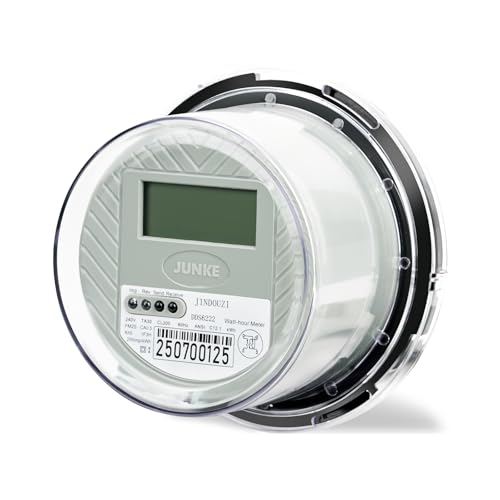
This meter is designed for RV and home electricity monitoring with a 240V working voltage. It features a high-definition LCD display and precise readings, achieving about 0.5 accuracy for reliable consumption data. It supports TA30 current measurement and CL200 energy monitoring, making it suitable for typical RV hookups and residential use. The device complies with ANSI C12.1 safety standards, ensuring standard electrical safety and measurement performance in various energy environments.
Digital Electric Meter For RV Pedestal

This 240V, 3-wire meter is positioned for RV pedestals and electrical panels, delivering reliable KWH measurements in common RV and home power setups. With a Class 200 (CL200) rating and 30 A test capability, it offers solid monitoring for daily energy use. Its compact design makes it a practical choice for travel trailers and park model RVs, while maintaining compatibility with standard 240V distribution schemes.
Itron Centron SSEM CL200 KWH Meter

The Itron Centron SSEM model provides an electronic LCD register protected by a polycarbonate cover, with a focus on unattended processing and reliability. It’s designed for 240V systems and forms part of versatile residential or RV energy monitoring, leveraging its CL200 rating for consistent performance across varying load conditions. A compact form factor makes it suitable for wall-mounted or panel installations in mobile or stationary settings.
Digital Electric Meter 120V 2 Wire

This 120V, 2-wire meter mirrors the 240V counterpart in design, offering a high-precision LCD display and accurate measurement up to 0.5. Suited for RVs and homes with standard US 120V circuits, it aligns with ANSI C12.1 safety and measurement standards. The device helps track daily energy use and supports general household as well as recreational vehicle energy management with dependable CL200-compatible performance behind a simple, easy-to-read interface.
Upgraded Watt Meter Plug Home Electricity Monitor

This plug-in meter is a compact home energy monitor with 7 display modes. It tracks power (W), energy (kWh), voltage, current, frequency, power factor, and cost, offering a comprehensive snapshot of appliance usage. The large backlit LCD is visible day or night, and the 180-degree viewing angle makes it easy to read from multiple positions. It includes an overload protection feature to alert users when a device draws too much power, aiding safe operation in RVs and homes alike.
Upgraded Watt Power Meter Plug With Backlight

A multi-function energy monitor with eight display modes, this MECHEER device expands on basic meters by offering cost calculations and total energy use views. It provides voltage, current, wattage, and more, with an adjustable backlight and overload warning to support safer operation in RVs, homes, and temporary setups. The unit’s ABS housing adds durability for mobile installations and frequent transitions between campsites or workplaces.
Buying Guide
- Voltage compatibility: Choose meters that match your setup—240V meters are common for RV hookups with Grade 1 electrical supply, while 120V meters suit most home circuits. For mixed-use RVs, a dual-capable meter can simplify inventory.
- Measurement range and accuracy: Look for meters with at least 0.5 precision and CL200 compatibility for reliable daily monitoring. Higher accuracy helps detect small changes in consumption, useful for budgeting energy use in RV parks.
- Display readability: A bright LCD with backlighting improves readability in bright daytime and dark camping sites. Some models offer adjustable backlight time and 180-degree viewing angles for flexible placement.
- Display modes and data depth: Meters with multiple display modes (W, kWh, V, A, PF, cost) provide a fuller picture of energy behavior. If you want cost-tracking features, ensure the device can calculate cumulative energy costs.
- Safety and standards: Ensure the meter adheres to ANSI C12.1 or equivalent standards for safety and interoperability with common RV and home electrical systems.
- Form factor and installation: Consider whether you need a wall-mounted, pedestal, or plug-in meter. Pedestal and panel-mount meters are common for RV parks, while plug-in meters offer portability for temporary use.
- Durability and environment: For RV use, choose meters with rugged housings and good temperature tolerance. ABS plastic housings are common and adequate for travel environments.
- Overload protection: Overload alerts help prevent damage to appliances and circuits. Some meters flash warnings when the load exceeds the safe threshold.
All five options provide objective data to inform energy decisions, whether you’re optimizing RV energy use on the road or monitoring home electricity consumption. When selecting, weigh voltage compatibility, measurement accuracy, display clarity, and the degree of data you need for budgeting and safety.