Best Solar Panel Extension Cables for Outdoor PowerSetups
Choosing the right extension cable for a solar array is essential for maximizing efficiency and ensuring long-term durability. This guide examines top-rated 10 AWG and 12 AWG extension cables designed for outdoor solar installations, RVs, and off-grid setups. Each product highlighted below offers robust connectors, weather resistance, and low resistance to minimize energy loss. Read on to compare features and find the best match for your solar project.
| Product | Brand | Key Feature | Amazon Link |
|---|---|---|---|
| 10AWG 30FT Solar Panel Extension Cable | Bateria Power | Flame-retardant sleeving, tin-coated copper, IP68 connectors | View Product |
| VALEMO Solar Cable 20 Feet 2×10 AWG | Valemo | Two twin wires with reinforced protection | View Product |
| Renogy 20FT 12AWG Solar Panel Extension Cable | Renogy | UV resistant, built-in connectors, waterproof | View Product |
| energeaster 10AWG Solar Extension Cable | energeaster | Tinned copper, TÜV/UL certified, dual XLPE insulation | View Product |
| Vansdon 2×30 Feet Solar Panel Extension Cable | Vansdon | Tin-plated copper, IP67, XLPE/XLPO insulation | View Product |
Bateria Power 10AWG 30FT Solar Panel Extension Cable
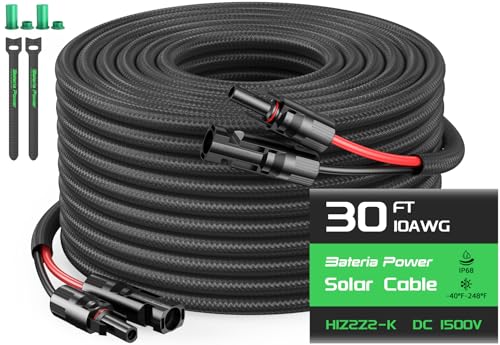
The Bateria Power 10AWG 30FT solar extension cable features a heavy-duty flame-retardant protective sleeving that enhances abrasion resistance against dragging, tangling, and daily wear. The sleeving simplifies coiling and operation while withstanding temperatures up to 248°F (120°C). It uses 10AWG tinned pure copper conductors, delivering approximately 30% lower resistance than standard 12AWG or 14AWG cables, which helps minimize power loss over longer runs. The cable is TÜV-certified for safety, with XLPO insulation and jacket providing flame resistance, UV protection, and broad operating temperatures from -40°F to 248°F (-40°C to 120°C), making it suitable for outdoor solar arrays exposed to sun, rain, or snow.
VALEMO Solar Cable 20 Feet 2×10 AWG Twin Wire

The VALEMO solar extension cable presents a straightforward dual-twin-wire layout (two conductors side by side) with reinforced ends to prevent splitting. It uses copper strands with tin coating to resist oxidation, maintaining conductivity over time. The dual-wire design helps with easy identification of positive and negative leads in outdoor installations, while the reinforced construction minimizes wear at connector points in harsh conditions.
Renogy 20FT 12AWG Solar Panel Extension Cable

Renogy’s 20-foot 12AWG extension cable features hard plastic connectors on both ends, offering robust attachment for solar panels and inverters. The black UV-resistant wire is designed to withstand sunlight exposure and rain, with a waterproof construction and TUV testing. This option emphasizes durability and stable power transmission, suitable for longer runs in residential or RV solar setups where weather exposure is routine.
energeaster 10AWG Solar Extension Cable

energeaster offers a 10AWG solar extension with a dual-core design, tin-coated copper conductors, and a heavy-duty outer jacket. The cable is TÜV and UL certified, with XLPE insulation providing better heat resistance. The outer insulation is designed to withstand outdoor conditions from -40℉ to 194℉, and UV resistance helps extend the cable’s life in direct sun. This option emphasizes safety and long-term performance in challenging environments.
Vansdon 2×30 Feet Solar Panel Extension Cable

Vansdon provides a dual 30-foot extension with 10AWG tin-plated copper conductors. The package includes one red and one black cable, clearly distinguishing positive and negative lines. The cables are designed for long outdoor runs with IP67-rated waterproofing and robust XLPE and XLPO insulation. This configuration is well-suited for larger RV or stationary solar arrays where long-distance energy transfer is required.
Buying Guide
Key purchase considerations for solar extension cables include conductor size, length, and durability. A lower gauge number (like 10 AWG) reduces resistance and power loss over longer distances, but thicker cables cost more and are less flexible. Consider the total run length between panels, charge controllers, and batteries to select an appropriate length without excessive sag.
- Conductor material and corrosion resistance: Tin-coated copper provides better longevity in outdoor environments than bare copper.
- Weather resistance and insulation: Look for UV resistance, flame retardant jackets, and XLPE/XLPO insulation that withstands extreme temperatures and weather.
- Connectors and waterproofing: IP ratings (e.g., IP67/IP68) indicate resistance to water and dust. Durable connectors with secure locking reduce disconnects in windy or snowy conditions.
- Certifications: TÜV, UL, and CE certifications indicate compliance with safety and performance standards.
- Durability features: Flame-retardant sleeving, abrasion resistance, and reinforced ends help extend cable life in rugged setups.
For most residential and RV solar projects, a 20–30 foot length with 10 AWG conductors offers a balance between flexibility and efficiency. If you need longer runs, ensure the cable has sufficient insulation and robust connectors to minimize voltage drop. When installing, route cables away from sharp edges and heat sources, and seal any junctions to preserve waterproofing.
In summary, the best choice depends on your setup: Bateria Power and Vansdon provide strong protection and long-term durability; Renogy offers built-in UV resistance and waterproofing; energeaster emphasizes certification and extended temperature tolerance; VALEMO provides reinforced twin-wire design for easier installation. Evaluate your distance, exposure, and safety requirements to decide which extension cable best fits your solar array.