Best Grinding Wheels for Carbide Bits: Sharp, Durable Options for Precision Work
Get the right grinding wheel for carbide bits to improve tool life and edge quality. This guide highlights five durable options that balance hardness, grit size, and stability for sharpening carbide tools, drill bits, and precision blades. The listed products are best for hobbyist workshops, metalworking setups, and professional machinists seeking consistent performance. Use the following buying guide to compare grit, arbor compatibility, and intended uses before purchasing.
| Product | Grit | Best For |
|---|---|---|
| POLIWELL 6 Inch Bench Grinder Wheel – 60 Grit | 60 | Heavy material removal on carbide bits; initial shaping |
| AmaCupid 6 Inch Bench Grinding Wheel – 80 Grit | 80 | Sharpening carbide tools with refined finish |
| Dremel 85422 Silicon Carbide Grinding Stone | Silicon carbide stone (not a wheel) | Detail grinding on small carbide tools and hard materials |
| POLIWELL 6 Inch Bench Grinder Wheel – 150 Grit | 150 | Finish grinding and polishing carbide bits |
| POLIWELL 6 Inch Bench Grinder Wheel – 80 Grit | 80 | Balanced sharpening with better surface finish |
POLIWELL 6 Inch Bench Grinder Wheel – 60 Grit

Reference: Green silicon carbide with high hardness and wear resistance. The wheel is balanced for smooth operation and manufactured with a 1/2” arbor compatibility for most 6 inch bench grinders. Use for shaping carbide bits, blades, and knives. Best for buyers who need aggressive material removal and robust wheel construction. Caution: Wear safety gear and verify wheel balance before use.
Best for:
- Users needing fast material removal on carbide tools
- Shaping and rough grinding on drill bits and blades
AmaCupid Bench Grinding Wheel – 80 Grit

Reference: Dynamic balancing tests ensure stable operation with minimal vibration. Made from high-quality silicon carbide and adhesive sintered at high temperature for durability. This wheel is sharp and wear-resistant, suitable for carbide tools and non-metallic materials. Best for buyers wanting a balanced wheel with strong thermal performance. Limitation: Not ideal for very tough workpieces that require extreme toughness.
Best for:
- Precise sharpening with less vibration
- Carbide tools and non-metallic workpieces
Dremel 85422 Silicon Carbide Grinding Stone

Reference: Silicon carbide grinding stones turn a rotary tool into a compact grinder for sharpening, deburring, and general purpose grinding on harder materials. Designed for stone, glass, ceramic, porcelain, gemstones, and non-ferrous metals. Best for buyers using a rotary tool for fine detail work. Caution: Not a heavy-duty wheel; use on smaller, precise tasks.
Best for:
- Detail work with a rotary tool
- Sharpening and deburring small carbide accessories
POLIWELL 6 Inch Bench Grinder Wheel – 150 Grit
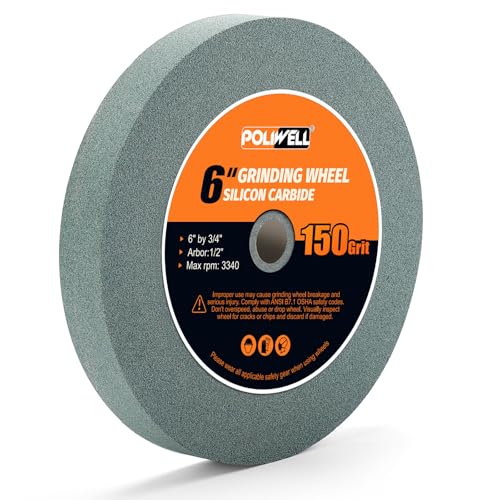
Reference: High-hardness green silicon carbide with a long manufacturing bake at high temperature before molding for improved hardness and brittleness. Standard 1/2” arbor hole size fits common 6 inch bench grinders. Best for buyers needing a finer finish on carbide bits after rough grinding. Caution: May require extra stock removal time on very hard materials.
Best for:
- Finish grinding and polishing carbide bits
- Light deburring with a refined surface
POLIWELL 6 Inch Bench Grinder Wheel – 80 Grit

Reference: Reiterates the same manufacturing standard as the 60- and 150-grit variants, with a 1/2” arbor fit for most 6 inch bench grinders. Best for buyers who want a balanced wheel that offers a middle-ground between aggressive removal and fine finishing. Caution: Check wheel compatibility with your grinder model before purchase.
Buying Guide: Key Considerations For Carbide Grinding Wheels
What grit should you choose? Lower grits (60–80) remove material quickly and shape carbide bits, while higher grits (150) finish and polish the edge. Consider the arbor size; most 6 inch wheels use a 1/2″ arbor, but verify your grinder. Material hardness matters; green silicon carbide is common for carbides due to brittleness and sharp cutting action. Safety gear is essential, including eye protection, gloves, and a face shield. Balance and heat management influence wheel life and performance. For mixed tasks, keep a set of wheels with different grits to switch between shaping and finishing.
How to pair with your tools? A dedicated bench grinder setup is ideal for binning grinding tasks into separate wheels, which minimizes cross-contamination between materials. If you primarily work with carbide, avoid wheels with too high a tendency to load clay binders, which can dull quickly under precise finishing tasks. For rotary-tool work, a silicon carbide stone provides versatile small-scale grinding, particularly on stones, glass, and hard ceramics.
Practical questions for buyers
- What is the intended material and target edge quality? Choose grit based on whether you need rapid material removal or a polished finish.
- Is the grinder arbor compatible with the wheel? Most 6″ wheels fit 1/2″ arbors; confirm before purchase.
- Will you apply light or heavy pressure? Harder wheels tolerate higher pressure but may wear faster if misused.
- Do you need a wheel for general sharpening or detailed finishing? Consider a set with 60/80/150 grit options.
FAQ
- Can I use a silicon carbide grinding wheel on carbide bits? Yes, silicon carbide wheels are commonly used for carbide tools due to their hardness and brittleness.
- What is the difference between a wheel and a grinding stone? A wheel is disc-shaped for bench grinders; a grinding stone (like Dremel 85422) is a handheld stone for precision work.
- Is a balance test important for grinding wheels? Yes, balanced wheels reduce vibration and improve edge quality during operation.
- What safety gear should I wear? Eye protection, gloves, and a dust mask or respirator as needed.
- Should I use multiple wheels for different tasks? Using dedicated wheels for shaping and finishing can extend wheel life and improve results.