Answering your search for reliable, low-pressure power washers that still deliver solid cleaning results. This guide highlights compact options ideal for cars, patios, decks, and light-duty outdoor tasks. Best for homeowners who want gentle, safer cleaning on delicate surfaces without sacrificing effectiveness.
Below is a quick buying snapshot to help you compare, followed by detailed product profiles. The table highlights key capabilities to aid side-by-side decisions.
| Product | Max PSI | GPM | |
|---|---|---|---|
| Greenworks 1800 PSI | 1800 | 1.1 | Light residential tasks like cars, patios, furniture |
| Greenworks 1600 PSI | 1600 | 1.2 | Delicate surfaces, quick cleanups |
| Sun Joe SPX1000 | 1600 | 1.1 | Portable cleaning on cars and decking |
| Westinghouse ePX3050 | 2100 | 1.76 | Fences, driveways, and home exteriors |
| Westinghouse ePX3100v | 2100 | 1.76 | All-purpose light-to-medium cleaning |
Greenworks 1800 PSI Electric Pressure Washer

Best for everyday light cleaning tasks where a compact, low-noise unit is preferred. This model delivers 1800 PSI at 1.1 GPM, making it suitable for cars, outdoor furniture, decks, and windows. The unit is promoted as maintenance-free with no gas, oil, or spark plugs required, and includes a 35-foot power cord with a GFCI plug for safety.
Who it’s best for: casual homeowners seeking a simple, budget-friendly option for routine chores. Why selected: it balances adequate cleaning power with safety features and minimal maintenance. Caution: not ideal for heavy-duty stains or large concrete surfaces.
Greenworks 1600 PSI Electric Pressure Washer

Best for delicate surfaces and quick touch-ups where gentle cleaning is key. With 1600 PSI and 1.2 GPM, this model is well-suited for cars, boats, windows, and light patio furniture. It emphasizes no-maintenance operation and a safety-focused design with a push-button start and GFCI protection.
Who it’s best for: homeowners cleaning sensitive surfaces or seeking a compact unit. Why selected: lower PSI reduces risk of surface damage while still delivering enough force for light to moderate cleaning. Caution: may require more passes for stubborn grime on tougher jobs.
Sun Joe SPX1000 Electric Pressure Washer

Best for portable, lightweight cleaning needs like car washes, patio furniture, and deck maintenance. It offers 1600 PSI at 1.1 GPM and includes an adjustable wand with a nozzle range suitable for different surfaces. The Total Stop System helps conserve energy by stopping the pump when not in use.
Who it’s best for: buyers prioritizing portability and ease of use. Why selected: compact design plus adjustable spray makes it versatile for small to medium tasks. Caution: extended use on tough stains may require higher PSI models.
CRAFTSMAN Electric Pressure Washer CMEPW1700

Best for a compact, versatile, entry-level option with solid cleaning power. This unit provides 1700 PSI at 1.2 GPM, includes a soap applicator bottle for cleaning with soap, and features onboard storage for nozzle, hose, cord, and wand. It’s suitable for cars, driveways, patios, and light garage tasks.
Who it’s best for: homeowners needing a single, lightweight unit that handles multiple light chores. Why selected: balance of power, ease of use, and integrated storage. Caution: smaller size means it may struggle with heavy-duty, large-area cleaning.
Westinghouse ePX3050 Electric Pressure Washer
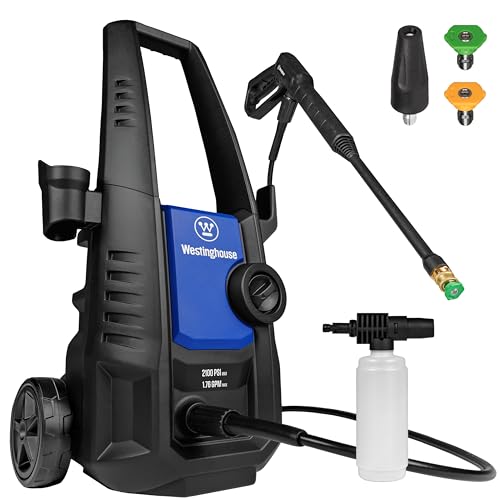
Best for mid-range cleaning tasks where higher PSI supports tougher dirt without excessive force. This unit delivers up to 2100 max PSI and 1.76 max GPM, with an included soap applicator and a compact, mobile design. It’s suitable for decks, sidewalks, and vehicle washing.
Who it’s best for: homeowners seeking a capable, mid-power washer for general outdoor cleaning. Why selected: solid performance at a reasonable size and feature set. Caution: higher PSI means more care is needed on delicate surfaces.
Westinghouse ePX3500 Electric Pressure Washer

Best for more demanding outdoor cleaning tasks while still staying in the low-to-mid PSI range. It provides 2500 max PSI and 1.76 max GPM, with a pro-style steel wand, onboard 20-ounce soap tank, and a four-nozzle set. It’s effective for heavy grime on driveways, fences, and patios.
Who it’s best for: homeowners who need a capable, compact unit that can handle tougher spots. Why selected: strong cleaning power in a portable form factor. Caution: higher PSI requires careful use on soft surfaces to avoid damage.
Buying Guide
- Surface sensitivity: For delicate surfaces like wood decks or refined pavers, opt for 1600–1800 PSI to minimize damage.
- Water flow: Higher GPM improves cleaning speed. If you have larger areas, prioritize models with at least 1.2 GPM.
- Portability and storage: Look for compact designs with onboard storage or easy-fold handles for garages and sheds.
- Safety features: GFCI protection, automatic pump stop, and insulated triggers help prevent accidents during use.
- Detergent compatibility: Soap tanks or detergent application improve cleaning on stubborn grime; verify nozzle compatibility.
- Wand and nozzle versatility: A quick-connect nozzle set and a swiveling wand offer flexibility for multiple tasks.
- Maintenance needs: Electric-powered units generally require less maintenance than gas-powered models, with simpler startup procedures.
- Task alignment: Choose based on your typical tasks—light cars and patios, vs. decks and fences that might demand higher PSI.
Frequently Asked Questions
- What is a good PSI for low-pressure cleaning? Typically 1000–1800 PSI is suitable for light to moderate cleaning without risking delicate surfaces.
- Is higher PSI always better? Not for every job. High PSI cleans faster but can damage surfaces; choose based on surface type and stain severity.
- Do these units require maintenance? Electric units are generally low-maintenance compared with gas-powered models, but periodic nozzle checks and hose inspections help longevity.
- Can I use soap with these washers? Many models offer soap applicators or onboard tanks; ensure the detergent is compatible with your unit and surfaces.
- How portable should a low-pressure washer be? Prioritize lighter weights, carry handles, and compact footprints for easy movement around yards and garages.
- What surfaces should I avoid? Stone, brick, and finished wood can be damaged by excessive pressure; test on a small area first.