Best Reciprocating Saw Blades Bulk for Heavy-Duty Wood, Metal, and Nail-Embedded Cutting
If you’re tackling a large project or stocking up for frequent use, bulk reciprocating saw blades offer the best value and readiness. This guide highlights five bulk options suited for wood, nail-embedded wood, metal, and mixed materials. Each product is evaluated for best-use scenarios, durability, and potential limitations. The top picks are ideal for workshop professionals, DIY remodelers, and contractors who require dependable performance across demanding tasks. A quick buying table is included to help you compare core features at a glance.
| Product | Best For | |
|---|---|---|
| BATHTOI 25 Pack 9 Inch 6/12 TPI | Long wood trims; nail-embedded wood | Bi-metal with 8% cobalt for durability |
| HORUSDY 30Pack 9 Inch 6-12 TPI | Frequent wood cutting; renovation work | High-strength carbon steel for toughness |
| jinmg 25 Pack 9 Inch 8/14TPI | Nail-embedded wood and metal mix | Thicker blade with cobalt alloy for longevity |
| Souyou 50 Pack 6 Inch 14/18 TPI | Medium metal and wood with nails | Non-stick coating reduces heat and friction |
| EXMIATOV 25 Pack 9 Inch 14/18 TPI | Metal cutting; auto dismantling tasks | 8% cobalt; designed for metal cutting |
BATHTOI 25 Pack 9 Inch 6/12 TPI Reciprocating Blades

Best for large wood trimming and nail-embedded wood projects. These 9-inch blades use a bi-metal design with 8% cobalt, delivering longer life and faster cutting. They are compatible with all brands of reciprocating saws, making them versatile for workshop use. The non-stick coating helps reduce buildup during heavy use.
Who it’s best for: Professionals performing garden pruning, outdoor wood work, and fences with nails. Limitation: May not be optimized for precision metal cutting due to wood-focused tooth geometry.
HORUSDY 30Pack 9 Inch 6-12 TPI

Best for frequent wood cutting and renovation work. This bulk pack uses high-strength carbon steel blades designed to resist bending or breaking under heavy use, delivering stable cutting performance. The set is suitable for softwood, hardwood, plywood, and construction lumber, reducing friction and cutting time.
Who it’s best for: Carpenters and remodelers needing consistent wood-cutting blades in large quantities. Caution: Not specifically optimized for metal or nail-embedded wood, so use dedicated blades for those tasks.
jinmg 25 Pack 9 Inch 8/14TPI

Best for nail-embedded wood and mixed-material cutting. These 8/14 TPI blades are designed for maximum performance in nail-embedded wood, with a thicker bi-metal construction that offers longer life and reduced blade breakage risk. The design supports smooth cuts in fencing, pallets, and similar materials.
Who it’s best for: Contractors dealing with nailed lumber and metal fringe; choose this if nails are common in the workpiece. Limitation: Higher tooth count can be slower on very hard metal compared to dedicated metal blades.
Souyou 50 Pack 6 Inch 14/18 TPI
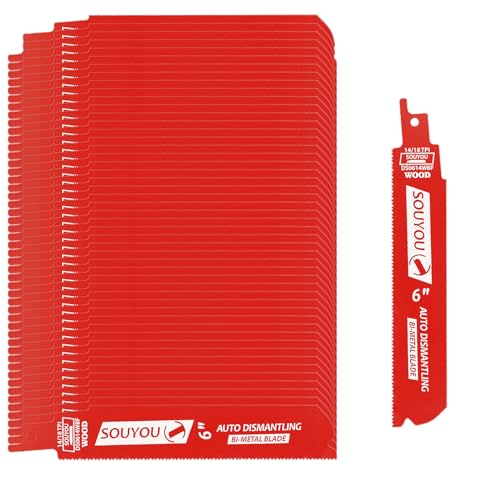
Best for metal and mixed-material tasks with nail-embedded components. The 14/18 TPI design combined with a non-stick coating minimizes heat buildup and friction, helping maintain blade life during metal cutting. It’s well-suited for a variety of metals and wood cuts at 6 inches.
Who it’s best for: Auto dismantling and metal fabrication tasks needing reliable metal-cutting blades. Caution: The 6-inch length may be less advantageous for deep-through cuts in thick materials.
EXMIATOV 25 Pack 9 Inch 14/18 TPI

Best for metal cutting with auto dismantling tasks. The 14/18 TPI blades use M42 bi-metal construction with 8% cobalt, providing strong cutting ability for pipes, steel, and similar metals. Each blade is 0.04 inches thick, offering durability for challenging metal cuts.
Who it’s best for: Professionals focusing on metal demolition and auto dismantling. Limitation: Primarily designed for metal; may not be optimal for nail-embedded wood unless paired with wood-specific blades.
Buying Guide: Key Considerations For Bulk Reciprocating Saw Blades
- Material compatibility: Choose bi-metal blades for mixed materials and metal cutting, while wood-focused blades excel in nail-embedded wood and soft/hardwood cuts.
- Tooth count and spacing: Lower TPI (teeth per inch) blades cut faster in wood and soft metals; higher TPI blades provide finer cuts and smoother finishes in metal and hardwood.
- Blade thickness: Thicker blades offer greater durability and reduced breakage in tough materials, but may require more effort for precise, fine cuts.
- Coatings and heat management: Non-stick or anti-friction coatings help reduce heat buildup and gumming, extending blade life in demanding tasks.
- Bulk value vs. task specificity: Bulk packs save time and money for frequent projects, but may include blades not optimized for every material; consider mixing blade types for best results.
- Compatibility: Ensure blades are compatible with your reciprocating saw brand and model for secure cutting performance.
FAQ
- What blade type is best for nail-embedded wood?
– Bi-metal blades with appropriate tooth design (often 8/14 TPI or 14/18 TPI) balance durability and cutting speed when nails are present. - Can bulk blade sets replace individual specialty blades?
– Bulk sets provide cost efficiency and readiness, but for specialized tasks (precise metal cuts or very thick materials), a dedicated blade type may still be preferable. - What is the advantage of cobalt-containing bi-metal blades?
– The cobalt alloy improves durability and heat resistance, reducing wear during tough metal or nail-embedded wood cutting. - How do I choose the right TPI?
– Lower TPI (6-12) for fast rough cuts in wood; higher TPI (14-18) for cleaner cuts in metal or dense wood; match to your primary material. - Is coating more important than blade thickness?
– Coatings help with heat reduction and gumming; blade thickness primarily affects durability and rigidity. Both matter for different tasks.