Best Remote Receiver for Ceiling Fans: Top Picks for Easy, No-Fuss Control
Upgrading a ceiling fan with remote control adds convenience and comfort, letting you adjust speed, lights, and timing from anywhere in the room. This guide highlights five reliable remote control kits that work across popular brands, including Hunter, Harbor Breeze, Westinghouse, Hampton Bay, and more. Each option features simple installation and solid signal reliability, so you can compare features and choose the best fit for your ceiling fan setup.
| Product | Brand | Key Feature |
|---|---|---|
| LPHUMEX Universal Ceiling Fan Remote Control Kit | LPHUMEX | 3-in-1 control, 5-wire hookup, wide compatibility |
| Universal Ceiling Fan Remote Control Kit Replacement | CENMING | 3-speed fan with light dimmer, reverse unavailable |
| Ceiling Fan Remote Control and Receiver Kit | Taigeguang | 4 timing settings, 4-button control, strong signal |
| Universal Ceiling Fan Remote Control Kit | CENMING | Dimming, DIP code pairing, 3-speed |
| LPHUMEX Ceiling Fan Light Remote Control Kit | LPHUMEX | Ultra-small receiver, universal AC compatibility |
LPHUMEX Universal Ceiling Fan Remote Kit
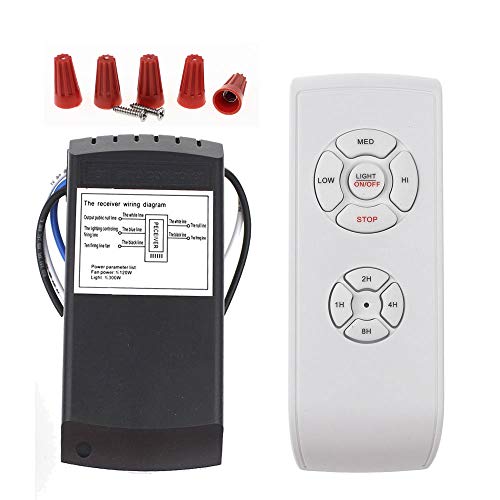
This 3-in-1 kit supports AC motors and pairs well with many brands, including Hunter, Harbor Breeze, Westinghouse, and Honeywell. Installation is straightforward with a five-wire hookup, which avoids removing the fan blades or light kit. It delivers a stable signal so you can adjust speed and lighting from across the room, improving bedtime and lounging comfort without leaving bed.
CENMING Universal Ceiling Fan Remote Kit Replacement
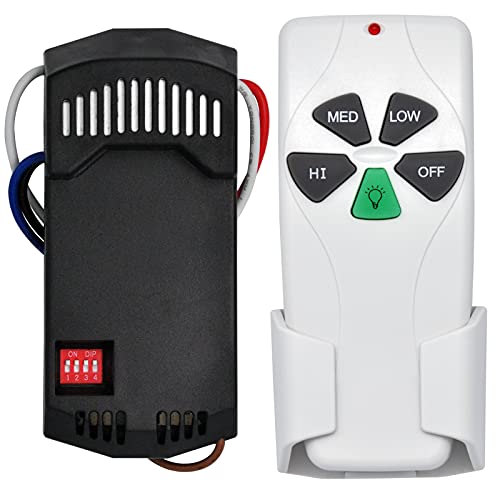
This kit supports Harbor Breeze, Hampton Bay, Hunter, Litex, and more, making it a broad replacement option for 110V 3-speed fans. It features a 3-speed fan control and a light dimmer, with a note that it lacks a reverse function. The design suits fans using separate control for light and fan, and the included receiver handles robust electrical load for reliable operation.
Taigeguang 3-in-1 Ceiling Fan Remote Kit

Taigeguang’s kit works with a wide range of fans and offers four timing options (1, 2, 4, 8 hours) plus remote-controlled fan speeds (high/medium/low) and light on/off. It emphasizes strong signal and includes support if you encounter installation challenges, making it a practical choice for bedrooms and living spaces where precise timing improves energy efficiency.
CENMING Universal Ceiling Fan Remote Kit with Light Dimmer

This model updates families of fans with 3 speeds and a dimmable light function, intended for 110V AC fans. It notes that the remote does not include a reverse feature, so compatibility with fans that rely on an existing reverse switch is important. The receiver is designed to handle a 240W load, supporting more bulbs and extending component lifespan.
LPHUMEX Ceiling Fan Remote With Ultra-Small Receiver

This ultra-small receiver fits into tight canopy spaces, expanding compatibility with many AC motor fans. It supports remote control of both fan speed and light, and is suitable for fans where the mounting bonnet is compact. Note that it is not compatible with DC motor ceiling fans, so verify your fan type before purchasing.
Buying Guide: Key Purchase Considerations And Comparisons
- Motor compatibility: Most kits support 110V AC motors, but some are specifically designed for DC motors. Confirm your fan’s motor type before buying to ensure full control of speed and light.
- Speed and light control: Look for kits offering 3-speed fan control and a dimmable light function. If you need only on/off for light, prioritize models that support that simplicity.
- Remote range and signal quality: A strong, stable signal allows control from rooms away or through walls. Consider products that advertise good signal and minimal interference.
- Installation complexity: Some kits require minimal wiring, while others involve more steps or canopy access. If you’re not comfortable with electrical work, choose a kit noted for easy installation.
- Size and canopy fit: Ultra-small receivers fit into tight canopies, while standard receivers may require more space. Measure your fan canopy before purchasing to avoid fit issues.
- Compatibility notes: Some remotes new to the market omit reverse functionality; ensure your fan has its own reverse switch if needed. Also verify compatibility with your fan brands (Hunter, Harbor Breeze, Westinghouse, Hampton Bay, etc.).
- Durability and power handling: Receivers with higher wattage ratings can better support multiple bulbs or brighter lamps. Look for units with robust relays and longer expected lifespans.
- Pairing and DIP codes: Some remotes require DIP code pairing to prevent cross-room interference. If multiple fans share a home, choose a model with easy DIP configuration and a clear default code.
- Warranty and support: Check the seller’s return policy and warranty details. In-field support or responsive customer service can be valuable for troubleshooting.
Overall, your best choice depends on your fan model, desired features (light dimming, timer, reverse capability), and how discreet you want the receiver to be inside the canopy. The selected options in this guide emphasize broad compatibility, straightforward installation, and reliable remote control performance across common American ceiling fan brands.