Best Speed Controller for Ac Motor Single Phase: Top Picks for Reliable Performance
Choosing the right speed controller for a single-phase AC motor is essential for precise control, safety, and longevity. This guide surveys five prominent options, highlighting features like voltage regulation, overload protection, and user-friendly interfaces. Each product is evaluated for resistive and inductive loads, compatibility with common voltages, and built-in protections to help you select a dependable controller for home workshops, DIY projects, or light industrial use.
A quick overview table summarizing the selected products is below. It provides a snapshot of key specs to help you compare at a glance.
| Product | Brand | Voltage & Current | Max Load | Notable Feature |
|---|---|---|---|---|
| AC Motor Speed Controller 120V 15A | CavalliFun | 110-120V, up to 15A | Resistive up to 2000W; Inductive up to 1000W | Independent overload protection with LED display |
| GRDM 10000W SCR Controller | GRDM | 120V-220V, up to 22A | Up to 2200W (at 120V typical) | Digital display; premium SCR components |
| ZOWZEA AC Motor Speed Controller 120V | ZOWZEA | 110-120V, up to 15A | Resistive up to 4000W; Inductive up to 1500W | LED display; back clip for belt mounting |
| Motor Speed Controller US-52-RED | FOXCUP | AC 220V, 50/60Hz | 300W/400W/500W ranges selectable | Forward/reverse control via wiring |
| Generic 750W VFD | Generic | 110-220V single-phase input; 3-phase output | 750W rated | Programmable external port; 3-phase output option |
AC Motor Speed Controller 120V 15A by CavalliFun

The CavalliFun controller is designed for 110-120V systems with a 15A maximum current. It supports resistive loads up to 2000W and inductive loads up to 1000W, making it versatile for fans, pumps, and small motors. Safety-focused features include surge and spike protection, RC absorption, and a flame-retardant shell. An independent voltage control switch provides overload protection to automatically shut off when current spikes above 15A. This layout emphasizes safety performance in a compact housing suitable for workshop benches.
GRDM 10000W SCR AC Variable Speed Controller
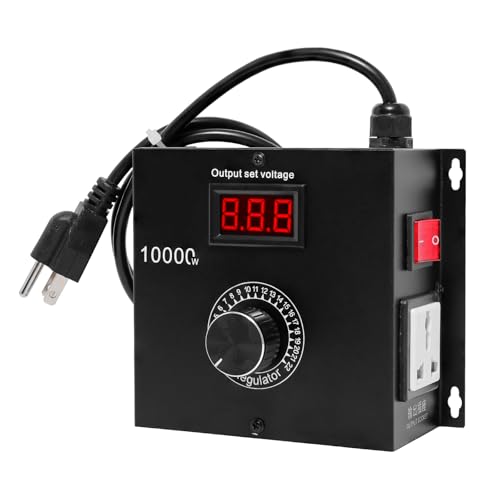
The GRDM controller offers broad voltage compatibility (120V-220V) with adjustable output up to 220V and a robust 22A capacity. Built with premium SCR components and high-voltage capacitors, it targets durable operation in demanding environments. Its interface includes a knob for regulation and a digital display showing output voltage, along with intuitive icons indicating temperature, light, speed, and voltage. This model is well-suited for power tools, kettles, stoves, and other high-load single-phase applications requiring stable speed control.
ZOWZEA AC Motor Speed Controller 120V

ZOWZEA’s 120V model combines back-clip convenience with a precise rotary knob and an LED voltage display for straightforward monitoring. Rated to 15A with a practical 4000W resistive and 1500W inductive load capacity, it emphasizes safety through a flame-retardant shell and automatic overload cut-off at 15A. The unit is useful for bench testing, DIY projects, and small industrial tasks where clean voltage regulation and easy mounting matter most.
FOXCUP Motor Speed Controller, US-52-RED

The FOXCUP US-52-RED provides adjustable speed for AC motors at 220V, with a range suitable for 300W, 400W, and 500W applications. It supports forward and reverse operation by swapping wiring jumpers on the back panel, enabling simple direction control once the motor is stopped. The description highlights its applicability across packaging, printing, electronics, and medical equipment production lines where precise drive control is needed and compact form factors are advantageous.
Generic 750W VFD: Single-Phase To 3-Phase Converter

The Generic VFD offers a 750W rating with single-phase input (110-220V) and three-phase output, enabling speed control for spindle, lathe, HVAC, or CNC applications. It includes programmable operation via an external port, allowing setup and adjustments for varying workloads. The device relies on modern MPU-driven control for efficiency and reliability, making it a solid option when converting single-phase supply to three-phase for compatible motors.
Buying Guide: Key Considerations For Choosing A Single-Phase AC Motor Speed Controller
- Voltage and current rating: Match the controller to your motor’s nominal voltage and continuous current. Over-specing can improve safety margins, but ensure the device fits the motor’s load profile (resistive vs inductive).
- Load type and power handling: Resistive loads (fans, heaters) often tolerate higher steady currents, while inductive loads (motors with inertia) require safeguards against surges and spike protection. Check maximum wattage ratings for both resistive and inductive scenarios.
- Protection features: Overload cutoffs, short-circuit protection, surge protection, RC absorption, flame-retardant housing, and thermal protection contribute to safety and equipment longevity. Consider models with independent protection switches for easier maintenance.
- Control interface and feedback: Knob-based regulation, digital displays, and LED readouts help monitor output voltage and speed. For precise applications, a controller with a clear display and stable regulation is preferable.
- Installation and form factor: Wall-mount, belt-mclip, or compact chassis options affect where the device can be installed. A back-clip design or lightweight enclosure can simplify mounting on benches or tool carts.
- Compatibility with motor type: Ensure the controller supports your motor’s phase and power class. Some devices are better suited for small to mid-sized motors and may not handle large industrial loads.
- Future readiness: If you anticipate upgrading to higher horsepower or different voltage systems, consider a VFD that supports a broader input range or higher output capacity to avoid replacement costs later.
- Warranty and support: A longer warranty and accessible customer support can reduce downtime when troubleshooting or upgrading setups.
When selecting a speed controller, consult motor datasheets and the controller’s documentation to confirm compatible voltage, current, and load types. For experimentation or hobbyist projects, starting with a model offering clear displays and robust overload protection can reduce risk and improve control accuracy. For industrial or high-load needs, prioritize devices with high-quality SCR components, reliable heat management, and explicit safety certifications.