Best Voltage Tester for Outlet: Top Picks for Safe Electrical Troubleshooting
Choosing the right voltage tester helps homeowners and professionals quickly verify outlet wiring, detect live circuits, and avoid electrical hazards. This guide focuses on outlet testers with clear readings, reliable non-contact options, and built-in features that simplify troubleshooting. Below you’ll find five well-rounded picks, each with a concise overview, practical uses, and key capabilities to match different tasks—from basic outlet checks to more advanced GFCI diagnostics.
Quick reference table of selected products. This table highlights each tool’s primary use, standout feature, and typical use case to streamline your buying decision.
| Product | Brand | Key Feature | Best For |
|---|---|---|---|
| Klein Tools RT250 GFCI Outlet Tester | KLEIN TOOLS | LCD readout with trip time display | GFCI receptacle testing and wiring faults |
| Klein Tools RT210 Outlet Tester | KLEIN TOOLS | GFCI and standard outlet testing | General receptacle safety checks |
| Klein Tools NCVT1P Kit | KLEIN TOOLS | Non-contact voltage detection plus GFCI test | Broad electrical diagnostics |
| Kaiweets Voltage Tester | KAIWEETS | Dual range 12V–1000V AC with LCD and alarms | Versatile voltage detection on low and high voltage |
| Klein Tools NCVT1P | KLEIN TOOLS | Non-contact AC voltage detection with visual and audible alerts | Quick live-wire indication |
All five options provide non-contact or contact testing capabilities suitable for outlets, switches, and wiring. The following sections break down each product’s strengths, typical scenarios, and how they compare in terms of safety features, accuracy, and ease of use.
Klein Tools RT250 GFCI Outlet Tester

The RT250 focuses on GFCI compatibility with an LCD readout that provides a clear voltage level and wiring condition indicators. This tester is especially helpful when diagnosing GFCI outlets in kitchens and bathrooms where rapid trip-time feedback matters. The large backlit LCD readout minimizes guesswork in dim workspaces, and the trip time display helps technicians verify that a GFCI device responds within expected parameters during troubleshooting. The device also detects common wiring faults, supporting safety and proper receptacle function in both new and renovated installations.
Use cases include confirming that a standard 120V outlet is wired correctly, verifying GFCI protection, and quickly pinpointing miswiring issues such as reversed lines or open grounds. The RT250’s emphasis on readability makes it a solid choice for job sites with variable lighting or users who prefer visual confirmation alongside audible cues. Its durability and straightforward interface suit both professionals and DIYers working on home electricals.
Klein Tools RT210 Outlet Tester
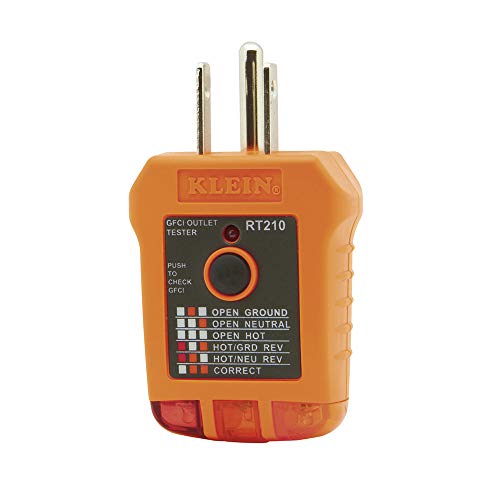
The RT210 is a compact, durable tester designed to identify common wiring problems in both standard and GFCI outlets. It’s built to withstand typical job-site drops and provides reliable indications of wiring status without requiring a battery or complex setup. Its straightforward testing logic helps confirm correct ground, neutral, and hot connections, making it a dependable choice for quick field checks or pre-work outlet assessments before panel work or device replacements.
Ideal for electricians, contractors, and homeowners performing routine outlet maintenance, the RT210 combines ease of use with essential diagnostics. It pairs well with other Klein Tools testers in multi-tool kits, offering a quick confirmation step before engaging in more intrusive wiring work. The device’s no-frills approach means it’s accessible to users at all experience levels, while still delivering trustworthy results.
Klein Tools NCVT1P Kit

The NCVT1P Kit combines a non-contact voltage tester with a GFCI receptacle tester, delivering a versatile set for broader electrical diagnostics. The non-contact tester automatically detects AC voltage across a wide range, while the GFCI tester portion verifies proper ground fault protection and receptacle integrity. This dual capability makes the kit useful for identifying live wires without direct contact and for confirming the health of GFCI-protected outlets, which is especially valuable in kitchens, bathrooms, garages, and outdoor outlets.
Users benefit from immediate visual and audible alerts when voltage is detected, and the large indicators help distinguish live versus neutral or ground conditions. The NCVT1P’s broader detection range and quick reference signals are suited for hands-on fieldwork, renovations, or service calls where multiple outlet types may be encountered. Pairing the non-contact tester with the GFCI checker streamlines workflow and reduces the need for multiple separate tools.
Kaiweets Dual-Range Voltage Tester

The Kaiweets tester is notable for its dual-range capability, covering 12V and up to 1000V AC with an LCD display and audible/visual alerts. Its safety-first design uses a clear indication system to show live status; red indicates higher voltage or live wiring, while green indicates low voltage or null wiring. The NCV inductive probe allows non-contact testing near terminals, outlets, or power cords, which reduces the need for opening enclosures when only voltage presence needs confirmation.
This model shines in scenarios like testing low-voltage lines for thermostats, doorbells, or irrigation wiring, as well as general high-voltage inspections. The adjustable sensitivity via a dedicated button adds flexibility for different environments, and the percentage bar graph provides an intuitive sense of signal strength. The Kaiweets tester is a strong choice for users who want a single tool that works across multiple voltage ranges and residential applications.
Gardner Bender GTK-2 Safety Kit

The GTK-2 Safety Kit includes a non-contact voltage tester and a GFI tester, offering a two-piece solution for broad electrical testing. The non-contact tester detects AC voltage and provides both visual and audible indicators, while the GFCI tester portion helps identify five common wiring errors in GFCI and standard outlets. This kit is well suited for quick site surveys, safety checks prior to wiring work, and routine outlet maintenance. The compact setup makes it convenient for field service vans or tool bags.
For users who want a quick, all-in-one diagnostic approach, the GTK-2 provides essential safety signals and practical wiring insights. It emphasizes ease of use and portability, which helps in stocking a lightweight tool for residential electricians and DIY enthusiasts alike. The inclusion of a GFCI tester alongside the non-contact probe makes it a practical entry point into outlet diagnostics without needing multiple separate devices.
Buying Guide: Key Purchase Considerations
- Voltage range and accuracy: Look for testers that cover common residential voltages (typically 120V) and, if needed, extended ranges for low and high voltage scenarios. LCD readouts and audible indicators help in quickly interpreting results.
- GFCI compatibility: For kitchens, baths, garages, and outdoor outlets, a tester with GFCI testing capabilities ensures you can verify proper protection and trip times, not just basic wiring.
- Non-contact vs. contact testing: Non-contact testers reduce risk when identifying live circuits and minimize the chance of arcing. Contact testers provide definitive wiring fault details but require closer proximity to conductors.
- Readability and indicators: Backlit displays, color-coded LEDs, and audible alarms improve usability in low-light settings and noisy environments.
- Durability and ergonomics: Choose tools that withstand drops, have compact form factors, and feature comfortable grips for extended use on job sites or renovations.
- Kit versus single tool: Kits that combine a non-contact tester with a GFCI tester offer broader diagnostic coverage, while single tools can be more affordable and simpler for occasional homeowners’ use.
- Brand and support: Reputable brands with robust customer support and readily available replacement parts can reduce downtime and improve long-term value.
In summary, selecting a voltage tester for outlets involves balancing the need for GFCI verification, non-contact detection, readability, and the specific contexts in which you’ll work—whether at home, on a renovation project, or in professional electrical service. The five products highlighted here provide a range of capabilities to suit common testing scenarios while prioritizing safety and clarity of readings.