Best Wall Timer for Lights and Home Automation
Choosing a reliable wall timer can simplify lighting schedules, save energy, and enhance home security. This guide highlights five top options that suit American homes, from backlit displays for easy programming to astronomical timers that align with sunrise and sunset. Each product section includes key features, setup notes, and practical use cases to help you compare quickly.
| Product | Brand | Key Features |
|---|---|---|
| BN-LINK 7 Day Programmable In-Wall Timer Switch (Blue Backlight) | BN-LINK | Blue backlight, 18 on/off programs, 7-day scheduling, 1-minute intervals, auto/manual modes, backup battery, random vacation mode |
| BN-LINK 7 Day Programmable In-Wall Timer Switch (No Backlight) | BN-LINK | 18 programs, 7-day options, auto/manual, backup battery, daylight savings, random vacation mode |
| BN-LINK 7 Day Heavy Duty Digital Programmable Timer | BN-LINK | Two outlets, 8 on/off programs, 7-day options, daylight savings, random vacation mode |
| DEWENWILS 7 Day In-Wall Timer | DEWENWILS | 7 on/off programs, DST, random mode, neutral wire required, backup battery |
| Toolhome 7 Day Programmable In-Wall Timer | Toolhome | Sunrise/sunset automation, 7 programs, local latitude/longitude input, backup memory, random mode |
BN-LINK 7 Day Programmable In-Wall Timer Switch With Blue Backlight

The BN-LINK blue-backlit model offers detailed scheduling with 18 on/off programs across seven days. The display remains visible in low light, which is helpful for late-evening programming. Use cases include living room lighting, ceiling fans, and motors that benefit from precise intervals. Features include day-by-day or preset combination days, one-minute interval granularity, and a backup rechargeable battery to preserve settings during outages. The device also supports a random “vacation” mode to mimic occupancy for security. This timer is suitable for single-pole and 3-way installations with neutral wire required.
Key considerations
- Backlight improves visibility in dim rooms or hallways.
- Rechargeable backup battery helps prevent lost settings after a power outage.
- Automatic daylight saving time functionality reduces manual adjustments.
BN-LINK 7 Day Programmable In-Wall Timer (No Backlight)

This variant focuses on robust scheduling without a backlit display. It still supports up to 18 on/off programs and seven-day planning, with minute-level precision. The unit allows easy toggling between AUTO and MANUAL modes, and includes a backup battery for resilience against power interruptions. Daylight Savings Time mode simplifies year-round use, while the random vacation mode helps create a lived-in impression when away. Ideal for outdoor or utility lighting setups where a backlight is not necessary but precise timing is essential.
Key considerations
- Backlight absence reduces glare but may require brighter ambient lighting during programming.
- Backup battery preserves schedules without external power.
- Compatibility with SPDT setups makes it versatile for different wiring configurations.
BN-LINK 7 Day Heavy Duty Digital Programmable Timer

Designed for higher-demand environments, this heavy-duty timer controls two grounded outlets simultaneously and supports up to eight on/off programs. It’s well-suited for lamps, fans, and security lighting that require synchronized switching. The device provides daylight savings mode, a backup battery, and a random vacation feature to obscure occupancy when you are away. With a rugged design, it’s a practical choice for workshops, garages, or utility rooms where more intense usage is common.
Key considerations
- Dual outlets offer synchronized control but require compatible loads.
- Longer duty may be beneficial for fixtures subject to frequent cycling.
- Durable construction supports harsher or more demanding environments.
DEWENWILS Indoor In-Wall Timer Switch
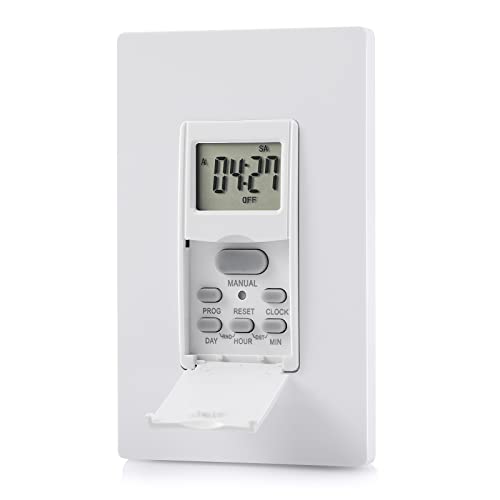
The DEWENWILS timer supports seven on/off programs per day with weekly repetition. It requires a neutral wire and includes a backup battery that preserves settings for several months during power outages. The device offers random mode to simulate occupancy and a DST option for time adjustments. It is a solid choice for indoor lighting, ceiling fans, and small motors where simple weekly scheduling is sufficient and reliability is key.
Key considerations
- Neutral wire requirement ensures stable operation with complex loads.
- Backup memory guards against loss of settings during outages.
- Simple 7-day scheduling is ideal for routine lighting patterns.
Toolhome 7 Day Programmable In-Wall Timer
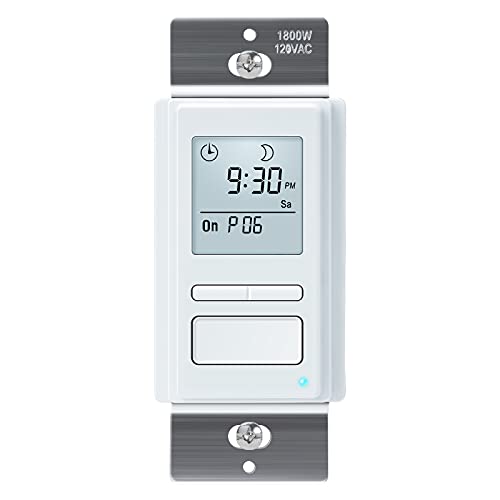
Toolhome’s timer uses sunrise and sunset calculations to automate lighting based on your local latitude and longitude. It supports seven on/off programs and can repeat daily or weekly. A built-in memory keeps schedules safe during power interruptions, and a random mode adds occupancy cues when you’re away. This timer is particularly appealing for exterior lighting or porch lights that benefit from natural daylight alignment.
Key considerations
- Sunrise/sunset automation reduces manual tweaks and energy waste.
- Program memory preserves settings after outages.
- Random mode enhances home security through occupancy cues.
Buying Guide: How To Choose The Right Wall Timer
When selecting a wall timer for lights, consider wiring compatibility, the number of controllable circuits, and the level of automation you need. If you want a simple, single-pole control with clear visibility, a backlit display can be invaluable. For spaces with frequent power interruptions, a timer with a reliable backup battery helps preserve schedules. If you prefer aligning lighting with natural day length, astronomical timers are a strong fit, though they require accurate time zone and location input. For home security, look for random vacation modes and daylight savings support that minimize manual adjustments during travel or seasonal changes.
Other practical factors include installation complexity, whether a neutral wire is required, and the availability of manual override options. Some models offer two outlets or multiple pre-set combination days, which can be convenient for living rooms, kitchens, or entryways. Durability matters in garages or workshops, where heavy-duty timers handle more demanding loads. Finally, verify compatibility with SPDT configurations if you have complex wiring needs or a three-way switch setup.
Additional Tips
- Label each timer with its intended room and load to avoid confusion during maintenance.
- Test the schedule after installation to confirm it activates and deactivates as expected.
- Pair timers with motion sensors or smart hubs for layered automation, if desired.