The following wireless light switch kits offer reliable remote control without rewiring, compatible with lamps, ceiling lights, fans, or plug-in fixtures. They emphasize easy installation, interference-free operation, and expandable configurations for multi-room setups. This guide covers five top options and provides practical buying tips for American homes.
| Product | Brand | Range | Power | Notes |
|---|---|---|---|---|
| Suraielec Wireless Light Switch and Receiver Kit | SURAIELEC | 100 ft | 15A/1875W | No wiring needed; includes wall switch and receiver |
| SURAIELEC Wireless Wall Switch Remote Control Outlet | SURAIELEC | 100 ft | 10A/1250W | |
| TREEWELL Wireless Light Switch and Receiver Kit | treewell | 200 ft | 10A/1200W | Long-range; simple installation |
| Suraielec 3 Way Wireless Light Switch | SURAIELEC | 100 ft | 15A/1875W | No wiring; supports 3-way setup |
| DEWENWILS Wireless Light Switch and Receiver Kit | DEWENWILS | 100 ft | Up to 100W per fixture (typical loads) | Detachable switch; compact receiver |
Suraielec Wireless Light Switch And Receiver Kit

This kit by SURAIELEC provides a no-wiring solution for adding or relocating wall switches. The relay receiver sits between power and lamps, while the portable remote controls lighting without disturbing existing systems. It includes a mounting bracket for wall switch placement and supports up to 15A/1875W, making it suitable for ceiling lights, lamps, fans, and some outdoor lighting. A key feature is its interference-free operation: dynamic codes allow multiple sets to coexist in the same room without conflicts. The compact receiver fits standard control boxes, and the remote remains user-friendly for mobility-challenged users. This option is ideal for homes upgrading to wireless control without extensive electrical work.
SURAIELEC Wireless Wall Switch Remote Control Outlet
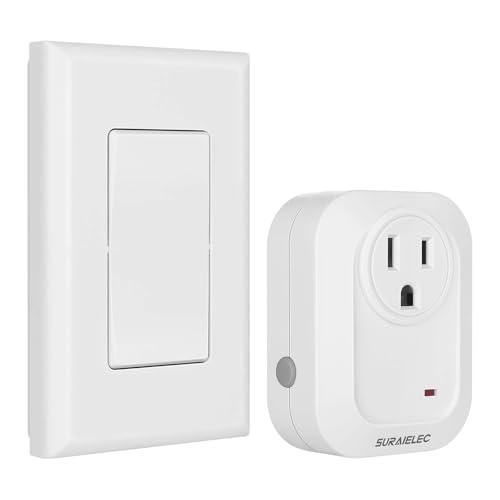
This wireless wall switch and outlet receiver from SURAIELEC enables remote control of plug-in fixtures and small appliances. No wiring or fixture replacement is required, making it a practical solution for lamps, indoor lighting, and hard-to-reach outlets. It ships ready to use and can be mounted with the included wall bracket, with the option to use the remote as a portable device. The system employs rolling or dynamic codes to avoid interference, allowing multiple kits to operate independently in the same space. Rated around 10A/1250W, it supports most common household bulbs and lamps.
TREEWELL Wireless Light Switch And Receiver Kit

The TREEWELL kit offers a 200 ft remote range, enabling control through walls and doors. It does not require rewiring; the receiver fits into small spaces such as junction boxes or canopy areas, and the remote switch operates with a quick, lag-free response. It supports up to 10A/1200W total loads (with specified limits such as tungsten, fluorescent, and LED ratings), making it versatile for lamps, fans, or other fixtures. The long-range capability makes it well-suited for larger rooms, multi-room homes, or spaces with thick walls where standard remotes struggle.
Suraielec 3 Way Wireless Light Switch

This 3-way version from SURAIELEC enables wireless control across two switches connected to the same light, without in-wall wiring. The relay receiver sits between the power source and lamps, and the wall switch can be mounted in any convenient location with the included bracket. It supports 15A/1875W and is designed to work alongside standard wall plates. The kit is pre-programmed for immediate use and uses rolling codes to prevent interference, allowing multiple kits to operate independently in a single home. It is well-suited for readers seeking practical 3-way wireless lighting control.
DEWENWILS Wireless Light Switch And Receiver Kit

DEWENWILS provides a no-wiring-needed kit with a detachable wall-mounted switch and a compact receiver. The 100 ft RF range enables reliable light control through walls and doors. The mountable switch can be placed in convenient locations, and the receiver fits into limited spaces like junction boxes. It’s designed to be user-friendly and compatible with many lamp types and fixtures. The kit emphasizes ease of setup and flexible placement, making it a practical option for renters, homeowners updating an older lighting system, or spaces where traditional switches are hard to access. FCC certification adds a note of regulatory alignment.
Buying Guide: Key Purchase Considerations
- Wiring and installation: Choose no-wiring-needed kits for quick setups, or models that require wiring if you need in-wall switches with a permanent fixture. Consider whether you want a portable remote vs. a wall-mounted switch.
- Range and signal reliability: Most options advertise up to 100 ft, with some reaching 200 ft. If you have thick walls or long hallways, prioritize longer-range models and those with rolling/dynamic codes to minimize interference.
- Power handling: Look at the rated current and wattage for each receiver. Common ranges include 10A to 15A and 1250W to 1875W. Verify compatibility with your lamps, fans, or fixtures.
- Number of ways: If you need 3-way control, select models specifically designed for 3-way wireless setups. Ensure the kit supports the number of switches you require.
- Interference management: Dynamic codes prevent cross-talk among multiple kits in the same space. This is crucial in busy homes with several wireless devices.
- Size and mounting options: Check whether the receiver fits standard control boxes or limited spaces. A bracket for mounting in rooms with mobility concerns can be valuable.
- Safety and compliance: FCC certification and compliance with local electrical codes can provide assurance for safe operation and regulatory alignment.
- Expandability: If you plan to scale to additional fixtures or rooms, choose kits that are easy to add to an existing system without reconfiguring other devices.
All selected products emphasize a no-wiring approach, straightforward installation, and reliable remote control compatible with common household lighting. When evaluating options, consider your room layout, fixture types, desired control method, and the level of future expansion you anticipate.